Friday, 17 September 2010

La Vanille

Some notes from our recent trip to Madagascar for a documentary film project:

I'm walking steadily along a red earth track, it's colour intensified by both sun and heat under the blue gaps in the heavy grey and white clouds. The damp sponginess of the red clay feels soft beneath the rubber of my shoes and the humidity is steadily tugging the sweat from my body as I strain under the weight of my rucksack. In the near distance I hear the familiar and jovial quacks of a family of ducks, and a warm smile pulls my face into shape, so that my expression is ready for the upcoming encounter. The merry sound of the quacking ducks and honking geese softens my heart as though I'm returning home after a long absence. In reality I am nowhere near my actual home. In 100 meters I enter a typical Malagasy rural village, and around me are children - snot-nosed and playfully running around in the moist red dust - and they gather in bunches shouting 'Salut Vazaha!' (Greetings Foreigner) at the very top of their voices. Among the children and wooden huts, there are chickens scratching away at the dirt for errant grains of rice, proud geese strutting around like they own the entire village (and beyond), and the friendly faces of adults and children alike will first stare and then light up into a glowing smile as I greet them back. "Salut Gasy!' I reply, and they stare, fascinated and giggling with mirth.

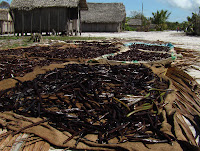


Trekking in the Sava and Masoala regions of Madagascar takes on a rhythm characterised by the above experience, but nothing can prepare you for the heady fragrance that inevitably catches you by surprise as you walk through the village, like walking into a wall of sweetness. Towards the centre of the village, a slightly metallic and sensory delectableness of prepared vanilla hits me like a blast of warm air, sensual, lusty, and every time I encounter it seems like first time!

Statistics claim that Madagascar (with Reunion and Comoros) produces something like 80% of the world's vanilla, and most of it is exported to the USA and Europe for ice cream production. It is also one of the main commodities produced in the very fertile SAVA region, others being rice, coffee, banana's, bread fruit, mangoes, coconuts, jackfruit, and others. The beautiful aroma of vanilla pods drying in the villages near where they grow is incongruous with the shiny and chocolaty brown pods that I see on the grass mats outside many of the village dwellings.
Speaking to the local farmers, they gladly describe to me the lengthy process and the years of effort and skill required to cultivate and prepare this commodity - very little of which is used locally, simply because it's value on the international market more than outweighs any opportunities for local consumption. A host plant, such as jatrofa must be prepared and planted, in just the right soil, with just the right aspect, and just the right amount of sun and shade to accommodate the vanilla vines. Lengths of vine are hand-planted individually at the base of the host, and after a few years (if not taken by disease) will begin producing the green beans. Pollination is by hand only, and each flower must be pollinated individually.


When the beans are ripe, they are hand picked and gathered. Soon they must by boiled in a specially constructed basket in a large cauldron over a wood fire for an exact number of minutes. On removal from the boiling water they are hurriedly wrapped in insulating material and put away for 2 days so that they remain at a high temperature. They must then dry in doors for some time before they can be laid out to dry in the sun. A year later they are dry enough to be sold to the co-operatives or transported to the nearest town. Bundles are individually prepared and each pod is massaged and stretched like a stiff muscle before it is bundled.

Such is the effort that gets put into preparing this bean which is then used in luxury food items.

Many stories and situations accompany these plump, sliverry shiny beans:
1) I met a vanilla farmer who, taking a break from stretching sinuous pods in his hand walked up to me and shook my hand. A few minutes later I lifted my hand to remove my hat, only to catch a whiff of the sweet aroma. Examining my hand I saw tiny little black specks, and realised that I had received my first authentic vanilla shake!
2) An English speaking student in the town of Sambava told me of the town thieves who prey on Vanilla merchants at night using their fine sense of smell.
3) Another Malagasy told of the dodgy Vanilla co-operatives who fill the pods with nails to bulk up the weight that they are sold at.
4) In books at tourist venues I found recipes for canard a la vanille (Vanilla duck), and in one fancy restaurant in Tana I had the most delectable meal of grilled fish in a creamy vanilla sauce.
5) Shops everywhere sell the delicious Malagasy vanilla yogurt in their plastic returnable cups, sweet and full of little black specks that I first mistook for dirt and refused to eat it!
6) Another NGO worker told me that farmers will destroy all their food crops to plant vanilla when the international price is soaring, and who then become destitute when the price falls again.
7) It felt decadent to be able to buy several large, heavy bundles directly from the farmers at a tiny fraction of the price it is sold in Antananarivo, let alone the price you'll pay for a dried out sliver in my local deli or speciality store in Cape Town.

And that is a short story of my encounter with this mysterious and notorious bean of the Red Island.

Stephen

Colours from Madagascar

Look what we found in the Madagascar National Park coumpound in Andapa village.... (This was taken on my cellphone as we didn't have our camera with us...)


The Red Island holds our hearts


Returning from Madagascar two weeks ago to Cape Town was tough.
After a month of travelling, filming and connecting with Malagasy people in some of the more remote regions of the country, it feels like life in Cape Town is too fast, full and intense. Comparably our daily lives in the rain forest regions of the north-east
and drier regions of south-west felt simple, clear and uncluttered.
Don't get me wrong, we were working all the time! We were meeting new people (villagers, conservation officials, guides, boatmen, young English students) everyday, filming on 2 cameras everyday (there was always something new and unique to capture) or arranging what the next location would be, and how we would get there.
But somehow, it felt that with our one objective of making a film that connects climate change, conservation and the beautiful people of Madagascar, we could stay focussed.

We we absorbing and capturing images in some of the most beautiful places I have ever been in the world. The Masoala National Park and adjacent coastline is a unique ecosystem where the rainforest literally meets the ocean. Tendrils of creeping vines hang over the yellow beach, brown-fronted lemurs eat leaves from the 100-year-old gnarled tamarind trees, a step away from the warm sea. Beyond the black rocks off the beach, the bay is filled with brightly coloured tropical fish and deeper in Antongil Bay, whales frolick with their calves.
Its breathtaking.

The Marojejy region, further up north gave us the opportunity to meet vanilla and coffee farmers. This was where we got our first REAL vanilla shake.... which is the most welcome, hearty handshake from a friendly vanilla farmer in this region! Malagasy people don't do confrontation, its just not part of their culture. So no one is ever angry or upset but always relaxed and open to whatever comes their way. Its makes for peaceful meetings and discussions. Always.
Here we also saw up close the silky Sifakas, which is a highly endangered species of lemur that lives only in certain parts of the island. And many other endemic reptiles, plants and gorgeously coloured birds. I miss the rain forests...


The rainforest regions we visited are so lush, that it became difficult to see the hardship and climate related problems the people here are experiencing.
But when we travelled to the south west near Toliara, the dryness and scarcity of water makes everything a lot clearer.
Water is scarce.
We filmed an extended family digging a well in a dry river bed to find water. It would take them whole day to find something. 50 km up the main road, people are travelling 7 or 8 km by foot to collect water in big buckets. And this will only get worse with the current predictions of climate shifts...

And now, back in CT, the work is in full swing. Local Malagasy people are doing translations for us via email, and I'm starting to sort and arrange all this footage we captured into something meaningful. And thats the challenge - turning such a rich, meaningful trip into a film that will move hearts and minds.

Watch this space.
Jacqueline


Wednesday, 1 September 2010

Joyce's Choices goes on Tour to the Eastern Cape!

On August 23rd, a small committed team set out from Cape Town to take Joyce's Choices (an innovative, interactive and high-quality performance) on a school tour! Reaching this point had taken months and months of hard work, preparation and determination. As we pulled out of Cape Town heading up the N2, Joyce was on her way to being introduced to learners at a variety of schools between Knysna and Port Elizabeth.

On the 23rd though, the number of performances was still uncertain because of the national strike underway...teachers were striking all over and many schools were uncertain about the week ahead. Principals were concerned about the possibility of intimidation and having to close schools completely. Even so, we set out with 3 confirmed performances, trusting that other performance opportunities would emerge as we travelled. We were right, when the week ended we had given 5 performances! Joyce, Nandi and Greg had met over 600 learners!

Each performance was unique because the environment and the audience gave the experience its own flavour. Our first performance took place in Kwanokuthula, a township just outside of Plettenberg Bay. We performed for mixed age group of 26 children residing at the Masizame Child and Youth Care Centre. The audience comprised of children between the ages of 7 and 15...their response to the performance was one of delight and for most of them it was the first time they were seeing a show with a puppet. They shrieked with delight when Joyce made her first appearance on stage. Fundi's sudden appearance from the TV for the game show "It's your choice" brought even more excitement! Throughout the show, the audience was engaged in what was happening.

Our second performance was on Wednesday at Bay College an Eco School outside of Plettenberg Bay. We performed for around 40 learners between grade 8 and 11. On Thursday, we were at the Crags Primary School in Kurland Township, performing for over 200 learners spanning grade 7 to 9. Our Friday morning was packed with a very early morning performance for around 150 learners at Collegiate High School and a second performance at Victoria Park High School for around 140 learners - both schools in Port Elizabeth.

Four of the performances from our first week on tour were followed by a workshop. This was an exciting space where audience members were asked to reflect on the content of the play and to imagine a world that they wanted to live in one day. It was amazing for all of us to see the future which many of the young people were longing for! Their futures were filled with restored natural environments and complex technologies to address the imact of climate and human needs. They were creative, inspiring and complex. Once the workshop participants had created their imagined worlds, we asked them to identify the specific actions they could take in their lives to begin to create a world they wanted to live in. This brought the discussion back into the present...again we were continuously reminded of the resourcefulness and resilience of young people to tackle the challenges they will have to face in their future!

More news to follow about the second leg of the tour at schools in and around Cape Town!

Tahirih Cook

Monday, 19 July 2010

Voices from the Red Island – A documentary film


Cosmos Productions has been recently granted funds by the NGO, Conservation International to make a documentary film that will give a voice to the local people of Madagascar. So we’re going back 1 year later, in August 2010!

On this project, I am collaborating with Stephen Davis (my husband) to create Voices from the Red Island, a social and environmental documentary film that captures how social and environmental issues intersect at critical points on the beautiful and fragile island of Madagascar.

Some info about the film….

The indigenous, rural people of Madagascar live in close connection to their natural environment. Their livelihoods depend on the natural world and inherently the forests and biodiversity of ‘the Red Island’ – the name coming from the colour of her fertile soil. With the current plundering of rainforests of rare hardwoods, (after a political coup that happened in February 2009 that left the country with weak rule of law), coupled with the devastation of 90% of the country’s forests for agriculture and charcoal through slash and burn practices, this natural environment is dwindling at a rapid rate. People living on the periphery of the forests are putting more and more pressure on Madagascar’s parks and reserves. At the same time, the local rural people experience climate changes and seasonal shifts that are happening on a global scale, as real problems. Cyclones are more intense, dry and rainy seasons are too short or too long, and crop yields are lower or entirely destroyed by extreme weather events.

For these people, climate change is already a reality, although they may not know how to name the phenomenon, they are increasingly realizing that the changes are not just an environmental issue, but also one with severe socioeconomic implications. It is a potential threat to their very existence and a major issue of human rights and equity.

This film aims to give a voice to these people.

We feel that at the interface of environmental destruction and climate change impacts, personal stories as testimonies of the adversities of climate change will move the hearts and minds of people in developed countries to redress the differences in ability to adapt and respond to the challenges of climate change and environmental degradation. Voices from the Red Island will demonstrate the interconnectedness of the human race; of actions, consequences and accountability.

So stay connected to our blog as we’ll be bringing you more updated info as we progress!

Jacqueline


Thursday, 8 July 2010

Paraphernalia takes the National Arts Festival by storm

In partnership with the Cape Town Edge, a collective of 11 Cape Town based companies, we did the long road trip to Grahamstown for the National Arts Festival to perform our show Paraphernalia.

After a long and grueling rehearsal process, Paraphernalia was a resounding success, selling over twice the amount of tickets than 2009. Paraphernalia was inspired by a little orange desk lamp that we’ve owned since childhood, and the Story of Stuff, an online video by Annie Leonard about where our stuff comes from and where it goes.

The story follows Stanley, a timid and self concious character who seeks more from life than just a stamping job and a friendship with a desk light. After an appointment with his therapist, and a blossoming relationship with his work colleague Felicity, he goes shopping and gets hooked by the world of consumerism and begins to loose connection to the important things in life.

The Official National Arts Festival newspaper, The Cue wrote:

An insightful and emotive look at the world of consumerism in the modern world told through the story of Stanley and his lamp. Half absurdist, half commedia del'arte this multimedia piece is endearing and innovative. It uses daily objects as moving, living characters along with gorgeously choreographed stage movement is captivating and thus this show becomes a shining example of true fringe theatre.”

As well as a fantastic review, the team were interviewed by Cue Online to create a podcast about the show and it's characters. On Friday's 2nd July we even had a feature story written about the show. Check out the links below.

The Paraphernalia team will be performing the show again in Cape Town. So watch this space!


Daniel

Tuesday, 6 July 2010

Lightness in our 'playing'


A journalist that came to see Paraphernalia at the National Arts Festival last week, commented on how we managed to create a lightness and quirkiness in our show although it was dealing with a serious issue.

Paraphernalia was born out of that exact intention: how we could use our various theatre talents and skills to tell a story that draws people in, entertains them but also brings an important message about social behaviour. We wanted Paraphernalia to be slightly off the
wall and absurd; we wanted people to chuckle
and giggle; and we wanted audiences to believe that desk lamps have feelings too...

Our 5 shows at NAF went off very well (other than a wobbly first show), and we received some great responses all round to the hard work we put in to bringing this story to life. Combining the skills and commitment of 3 great actors: Cassandra Hendricks, Daniel Robinson and Andrea van Meygaarden; the collaboration of Jesse Kramer, Jacqueline van Meygaarden and Liezel Reddeck on creating the masks and the commitment of a team who've worked with no reward for over a month, we pulled off something to be proud of!
Thanks all for a rewarding experience. You all rock!

Jacqueline