Wednesday, 18 September 2013

Unlocking the Gifts of energy

I recently had the privilege of working with Project 90 by 2030 again. I have worked with this 'change-focused' organisation in the past on a number of projects, including some of Cosmos Production's theatre and short video highlights. They are a team of dedicated, loving people who really believe in inspiring people and bringing about significant positive change in the way we all engage with earth systems, and each other. This mission is already an inspiration for me...


In the last few years, I know they have been making changes in communities all over South Africa relating to energy efficiency, renewable energy and generally finding innovative ways to support and help the vulnerable. The project I worked on with them last month, a short film about one of their projects in the Community Partnership Programme was about exactly that - supporting the vulnerable.

Unlocking the Gifts was filmed at the Sibongile Day and Night Care Centre - a care facility in Khayelitsha for children with cerebral palsy and other disabilities. The aim of the partnership with Project 90 was to improve energy efficiency, improve access to energy and reduce the costs at this Care Centre, to enhance the lives of these children. It was humbling to film at the daycare centre and night homes, where the carers give with so much love and patience to the children - EVERY DAY. I was moved by their commitment, and also moved by the children, who although we could not often communicate, I sensed their generosity, playfulness, and joy.


Click here to watch the video.

Lulama Dlodlwana, the house manager at one of the Day/night homes, who shared herself so openly.


Monday, 16 September 2013

WESSA and Environmental leadership

WESSA and Environmental Leadership

We recently worked with the WESSA Western Cape office to produce a short film about a year-long programme they ran for young environmental leaders. The Wildlife  and Environmental Society of South Africa (WESSA) have a mission to implement high impact environmental and conservation projects which promote public participation in caring for the Earth. 


The film which Cosmos directed and produced, Stepping up to Environmental Leadership is a simple overview of the programme through insights and comments from some of the participants.

As the filmmaker and someone interested in what LEADERSHIP means, I found it interesting that the programme gave the young participants full ownership of the course.  They had to decide what they wanted to learn, where they wanted to go on site visits, who they wanted to meet, and how they wanted to run it! It was a year long course with meetings and gatherings every month. So in every sense of the word, to take on the leadership of it... To be a leader means to lead on all levels.


Tuesday, 4 June 2013

Stop-motion films with kids!

Cosmos will again be working with Elemental Kids on their winter school holiday programme, from 24 to 28 June 2013. This year during the abundant rains of winter children will have an opportunity to create a stop motion animation film about, with and next to water. They will create the story, develop the characters, the set, film it and add sound. In the process children will be able to explore different roles in the film making process - story writing, directing, acting, set making and sound engineering. 

Cosmos will record sound effects that the children make theselves for their characters, and edit the film to a finished product, which they can watch at the end of the holiday programme. The screening is an exciting affair with popcorn all round!

  The holiday programme will be based at the Imperial Yacht Club on the banks of the vlei, and children will go out on the water with a variety of different boats during the week, have access to an endlessly entertaining Art Space and enjoy the beautiful outdoors with access to a cosy fire place in the club for the rainy winter days.  

To see the stop motion film from their FIRE holiday programme last year, watch it here: FIRE film. This was created by children aged 6 to 12 years.


Sunday, 3 February 2013

Fish and more fish... new work for Cosmos

Cosmos Productions will soon be starting some work with Cooked in Africa - a busy, exciting production company in Cape Town!Jacqueline will be editing some episodes of a reality tv series called Moving Sushi, about a South African couple that head out on a 2 year, 42 country expedition across East and West Africa, Europe and Asia. Their mission was to go and discover people and projects from around the globe that were making a difference in marine conservation despite the desperate situation the marine world is in. It's an exciting and important project as it puts the global condition of our oceans out there for everyone to see. And our oceans and the fish and marine life that live in it, are in a serious and vulnerable state, all over the world.

Its also a similar project to what Cosmos currently has in development about our trip to Madagascar a few years ago. While filming for Nosy Mena in 2009 we captured a lot of the journey and behind the scenes experience of our trip, which we are planning to make into a travel/cultural/environmental documentary. We discovered so much about ourselves and the issues threatening the biodiversity of Madagascar, that we feel there is a great story to be told there. Watch this space...

In the meantime, go check out more information on Moving Sushi here 

Wednesday, 6 June 2012

Cosmos Productions will be working with Elemental Kids  on their winter Holiday programme from 9 to 13 July 2012.


Elemental Kids create week long experiential, stimulating and fun programmes built around natural element themes. Each week we focus on one element. Children explore the elements through the arts, outdoor activities and play. The programmes are structured so children can choose to participate for the entire week or for a day at a time.


 In the winter programme, the children will be learning how to create a stop frame animation film which focuses on the illumination of fire! Children will work in groups on this collaborative project, developing their own stories, creating the props for the film sets from recycled materials and shooting their own footage. They will get to be story writers, prop makers, camera people, directors and puppetmakers. Cosmos will guide them in this process...


The Girl Effect


A simple, but powerful video that describes a simple but life changing way of thinking in our world. Social change needs women to be able to participate in their society.
Watch it.

This fits so closely with the work I did in 2009 with the international NGO, Gender CC, who aim is to integrate gender justice into climate change policies and local and international levels.

Friday, 1 July 2011

Trailer for our Madagascar documentary: Nosy Mena

This is a short trailer video of Nosy Mena: Voices from the Red Island. We're planning some screenings soon in Cape Town and other festivals relating to climate change at COP17.

Watch this space!

Jacqueline

Tuesday, 21 June 2011

New Silky Sifaka film by Earthtouch

This is a beautifully produced conservation video about the endangered Silky Sifakas in the Marojejy region in north-east Madagascar. 'Silkies' are beautiful, white lemurs that only exist in this region, and in our last two visits to Madagascar, we were privileged to see them both times, deep in the Marojejy National Park rain-forests. This film, Trouble in Lemur Land, shows how their habitat is being destroyed by the illegal Rosewood logging, which also formed an important part of our documentary film, Nosy Mena: Voices from the Red Island.

One of the featured scientists in this film, primatologist Erik Patel was also a core funder and supporter of our documentary film.

It's well worth the watch, as they have some spectacular footage of these endangered lemurs as well as saddening but powerful footage of the Rosewood logging.

Jacqueline

Tuesday, 5 April 2011

PARAPHERNALIA in Cape Town


PARAPHERNALIA, our quirky visual theatre show is finally in Cape Town! 

Come and share the magic from 16 to 21 April 2011 at the New Africa Theatre, in Sybrand Park.

This show was developed in 2008 and has grown from its original ideas into an 'endearing' and 'innovative' production that has inspired audiences at the National Arts Festival two years in a row.

Directed by Jacqueline van Meygaarden and co-created with Daniel Robinson and Andrea van Meygaarden. The latest incarnation of the show showcases the mask design of Jesse Kramer and Liesel Reddeck, and has Nadia Caldera (now Woodward) in the new role.

Tickets are R50 and R35 for block bookings. 
To book, contact Tahirih Cook on 084 873 4711 or tahirih.cook@gmail.com


Wednesday, 23 February 2011

Oscar nominated film about Madagascar


I recently watched this exquisitely beautiful short film about Madagascar and the journey of a traveller through the culture of the island. It's an animated film that uses many different animation and drawing styles.

I learned today that it was nominated for an Oscar! Watch it yourself, it takes you on a sensual journey...

It also brings me back to Madagascar in a heartbeat - the music, the colours and sights ... We'll have to plan to go back soon....

http://www.youtube.com/watch?v=afo20n40yBM

Thursday, 10 February 2011

Nosy Mena documentary review


We held a screening of our film, Nosy Mena: Voices from the Red Island to a public audience for the second time on 22 January. The first time was at the COPART Climate Fluency Exchange in December 2010, which gave us some excellent feedback!

This January screening, held at the Mountain Club of South Africa in Cape Town was attended by about 50 of our friends and colleagues, and some mountain club members.

Brenda Martin from Project 90 by 2030, one of our colleagues and friends wrote this great review about the film.

Click here to read it on her blog:

Saturday, 8 January 2011

More about memorable vanilla...


Vanilla


BOTANICAL NAME: Vanilla Fragrans, syn V. planifolia

FAMILY NAME: Orchidaceae


Aroma and Flavour:

Real vanilla is highly fragrant, with an exotic and memorable aroma. On our travels around north- east Madagascar, we were always surprised by the heady scents that wafted out of villages as we approached them. The taste reflects the smell, with a soft, flowery mellowness.


Culinary Use:

One of the finest flavours, used almost exclusively in sweet cookery, vanilla is added to cakes, ,biscuits, puddings and desserts. It is used to flavor confectionery, and has a special affinity to chocolate. (in Madagascar there is a good quality chocolatier called 'Roberts' who makes delicious dark chocolate slabs and truffles, and they all have real vanilla as an important ingredient).

Vanilla is one the distinctive ingredients in creme de cacao and Galliano, two popular liqueurs.


Medicinal and other use:

Vanilla is used as a pick me up, and an antidote to fevers. It is also associated with aphrodisiac qualities, and is used in perfume productions.


Storage:

Store one vanilla pod in in a jar of sugar (usually caster sugar), allowing 3 or 4 weeks for the full flavour to permeate the sugar fully, and just top up the jar with more sugar as required. This gloriously flavoured vanilla sugar is marvelous in cakes, biscuits, sweet pies, ice creams, and milk puddings. a good quality pod, with plenty of vanillin crystals, will remain potent for as long as four years!


Vanilla Flavourings:

Natural vanilla flavouring, extract or essence is made by finely shopping the beans or pods and infusing them by dripping alcohol on the pieces. Inferior pods are used; they may not be fgood enough for selling whole, but their flavour is fine. Madagascar bourbon is one example of a title given to superior vanilla flavouring.


Artificial vanilla essence or flavouring is light years away from the true flavour of vanilla. The flavour is synthesized from wood pulp waste, coal tar or coumarin, which is banned in many countries. Substantial quantities of the artificial flavouring are sold and used each year. This type of vanilla essence has a harsh flavour with a definite aftertaste.


Buy the vanilla pod or natural vanilla flavouring or essence and you will notice the difference in flavour.


For more information about vanilla, click here.


Tuesday, 9 November 2010

Joyce's Choices on tour in the Western Cape!


"Once again, a big thanks for coming out and performing your visual theatre show. We hope to meet you in the future when we work on some environmental programme."
Brian, Educator at Settler's High School

"Thank you so much for a splendid and highly professional performance...You have made an impact on our learners!"
Kathima, Educator at Rhodes High

"Thank you for your wonderful, up lifting performance! We have all enjoyed the show immensely, and have been inpsired by its message."
From the 2010 Herschel Grade 10's and staff

"Thank you for the thought provoking performance you shared with our students on Friday. This work you are doing is so important and the reinforcement of our serious environmental issues in such a creative way made a heartfelt impression on our students. I was fascinated by the use of the puppet and the BOX."
Janet, Educator at the American International School


These comments reflect the way our production, Joyce's Choices, was received at all 10 schools that we performed at in and around Cape Town in September this year. Our ability to perform for so many schools over the two week period was by no means a small feat because the national teachers strike (which started when we left for the Eastern Cape leg of the tour the week before) continued until the tour ended! Several schools that were situated in the townships around Cape Town were unable to have us come and perform because of the strike even though they were really interested. Educators and learners were often absent, understaffed schools struggling to cater for matric exams and in some cases schools had to close down completely. However, our determination to make sure our performances happened paid off!

Our first two performances in the Western Cape took place out in Somerset West at Mondeor Eco School and Somerset College. The latter was our biggest audience during the 3 week tour, Joyce was introduced to over 400 learners in a beautiful chapel where the cast was performing! Next we performed for over 300 learners at Herschel. This was the only performance that took place in a proper theatre environment during the tour. The cast loved being back on stage with sound and lights to support their creative work. There is something about the combination of lights and sound that contribute to the magic of theatre! We all want to thank Jesse Kramer with her technical support with the performance on that day. Our final performance during the second week of the tour, was for small group of performing art learners at the American International School. The educator who invited us to perform that day was overjoyed with the whole experience and eagerly asked us for ways to incorporate puppetry into her own educational programme at the school.

During the final week, Joyce, Greg and Nandi performed at another six schools! They started out at Simon's Town High School with another large audience of over 300 learners. Their next stop was a very early Tuesday morning performance at Sea Point High School. Later on in the same day, they performed for a second time at Rhodes High School for over a 100 learners. By Wednesday, the teacher strike was settling which made it possible for us to finally perform for learners at Masiphumele High School. This performance was originally scheduled for the previous week but had to be cancelled due to strike action. This performance was dramatically enhanced by Fundi's TV personality popularity! With over 200 learners in the auditorium that day, it was hard to leave when we were finished because of all the people still lining up to get her autograph. Thursday involved a scenic drive out to Betty's Bay, where Joyce's Choices was performed for a group of Grade 10 learners from Bridge House that were on a week long environmental camp. By friday we were all feeling a bit tired when we arrived for the final performance at Settlers High School out in Bellville, only to be revived by the sheer delight and enthusiasm of the audience! There were literally tears of laughter from learners throughout the performance that day!


The cast not only performed at 10 different schools during this two week period, they also conducted 8 workshops. Each workshop was a completely different experience, reflecting the interests and beliefs of the participants. Generally speaking, the workshops would start out by asking the audience what they thought about the play. Learners were invited to reflect on what had taken place, to respond to the story and the characters. Many were worried about how old Joyce was by the end of the play...they could see she had been alive for a long time! After this they were invited to close their eyes and imagine a world they wanted to live in one day...to really feel it and experience it. We wanted them to focus on the positive through this expercise rather than get stuck in what was negative about the world around them. In most cases, this approached proved to be very effective. Workshop participants created amazing worlds with innovative technology, new forms of human settlements, lush vegetation and happy people. The process of creating a world they wanted to live in one day appeared to release energy and enthusiasm about the future! However there were times when their negative beliefs seemed to block their ability to think about what they wanted and what was possible. In these situations, the workshop facilitators searched for creative ways to engage participants so that they could move beyond their beliefs about what could be achieved in the world.

Positive or negative responses aside - a number of fascinating conversations grew out of these workshops. Learners grappled with conflicting desires at Masiphumele, a desire to be successful and wealthy one day and a desire to care for the natural environment. It was challenging for learners to see how they could satisfy their personal desire for a particular form of success which was closely connected to the consumption of stuff and their realisation that it was the consumption of stuff which was contributing to climate change! Many workshop participants made a connection between the way Joyce was living her life of conspicuous consumption and the environmental deterioration in the play. They talked about the relationship between the way people were living and the impact it was having on their environment. Many knew about renewal energy and alternative forms of technology. We talked about how there many different ways one could respond to climate change...how one could be responsive just by becoming more responsible consumers. Without fail this process of performance combined with workshopped engagement made for a stimulating, generative experience for the learners, educators and the cast of Joyce's Choices!


It was with a combination of sadness and joy that Joyce's Choices school tour came to end after 3 weeks on the road. The cast had had an incredible experience, working together in this way can be intense and consuming. We all enjoyed being part of a team and it was sad to part ways (even though all of us were looking forward to having some time to rest!). The tour ended with a sense of joy because of the satisfaction we felt regarding the impact of the play on stimulating debate and engaging young people in a wide variety of learning environments. We all felt that we had achieved what we had set out to do! So over a 3 week school tour, the play was performed 15 times for over 2000 learners and we had facilitated 11 workshops! Hopefully, Joyce's Choices will be able to visit schools again in the near future to continue this important process of engaging young people about the future they want to create and what they are going to do to make sure it happens!

Tahirih


Tuesday, 26 October 2010

Post midnight serenades in rural Madagascar


An excerpt from Stephen's diary:

Its just after 1:30 am 12th August, in a small Malagasy village village called Befingotra in the Andapa region of northeast Madagascar. we are far away from any infrastructure, cut off by a mud pit they call a road, a high mountain pass, and a full day's walk and drive to the nearest town. This village is the starting point for excursions into the remote Anjanaharibe Sud special reserve, and we are camped in the yard of somebody's home.

Tomorrow we will hike around the area and interview the villagers for a documentary film we are shooting.

I’m woken in my tent by the sad and gentle singing of a man in prayer. The man told our guide before we set up our tents that he hoped he would not disturb us with his praying late at night. I have no idea what his beautifully sung words mean in the local Malagasy dialect of Tsimihety, yet they gently pierce the Nylon Fabric of my tent in a soothing, melodic and sad voice that awake something deep inside me. I am touched, and I am afraid that the meaning of the songs, if I could understand them would lose the magic of the music that transcends the words they contain.

My mind is filled with thoughts in this still, starry night, being here in this extraordinary country, and feeling compelled to capture our journey on film. This seems all very sentimental as I write it, yet I’m certain that a tale that has not been told in our human history wants to be told. The unsaid wants to be exclaimed, it is now ripe for the picking and it wants to be shared with those who are listening. I am drawn to be the picker of that fruit, through words, and through images on film.

My thoughts turn to people. Mosesy, our dedicated guide, a man of huge integrity and inspiration in his own right, and our soft-spoken driver Fabrisse, accompanied by his smiling young son, Milandro, the suave and talkative Faustin, and the porters and others giving so generously of their time to assist us in our mission. These people, and the places, and our own journey are conspiring in a mysterious way, and preparing us for the message that will move the hearts and minds of all those who come into contact with it. I personally feel humbled to be the conveyor of this message, one that I do not fully understand myself, yet I have the certainty that it exists.

The images and the opportunities that have presented themselves to us in the past few weeks up until now have been aplenty. We have discovered something that for us is unique, and it remains to be seen whether the inspiration exists in the other regions we will be visiting, or even beyond this country to others. Chances are this inspiration has existed for millennia, but I am only seeing it now.

So what is this mysterious and magical message that Jacqueline and I feel so compelled to share? Perhaps it’s something to do with the interconnectedness and love between human beings of vastly different cultures and ancestry, or that a country classified as being one of the poorest can be prosperous in so many ways? Or maybe, it’s the friendly smile that adorns the face of every person we have met, the lack of urgency, the abundance of productivity, the warmth, love, authenticity and accepting nature that many of them have as attributes. People alive with possibilities, desiring a preservation of their lush and fertile environment, seeking beneficial collaboration with the rest of the world; humble and perhaps unable to see their own greatness, and until now free of the clutches of desire for technological advances and monetary wealth. Already there exists abundance here; of knowledge, of agricultural subsistence; community support, preservation of resources for future generations and; respect for humanity.

My sense is that this abundance is not new. It has been passed down through many generations. Madagascar is a place that has embraced the diversity of its ancestry – the blend of African and Asian roots, and perhaps it is the unity of spirit that speaks volumes, and which these evening prayers have chosen to awaken within me. Who was this stranger that was sent to sing to me, like a child being sung to sleep by a loving parent. Who sent me this stranger to sing such beautiful and moving melodies in a language that I thought I could not understand…?

Stephen


Sunday, 17 October 2010

Have a great long life!


One of the best birthday gifts have ever received was on shoot in north-east Madagascar. We were staying at a rustic place called Tampolo Lodge which was on a marine reserve that was a 2 day walk or 3 hour speedboat ride from the nearest town. It is probably one of the most beautiful places I have ever been to....

Freshwater streams run directly from the rain forest of the Masoala National Park directly into the sea. The beach is a rich, warm yellow colour and backs onto the deep green forest with comet orchids dotted everywhere! The sky is continually shifting from dark rain clouds to light tropical rain to warm sun, and back again. Gorgeous.

We were also there with our friend, Augustin Sarovy, who was working as our translator and guide. So on 21 August, Augustin with some other boatmen and local fishermen sang me a birthday song - in 4 part harmony!

Jacqueline

Friday, 17 September 2010

La Vanille

Some notes from our recent trip to Madagascar for a documentary film project:

I'm walking steadily along a red earth track, it's colour intensified by both sun and heat under the blue gaps in the heavy grey and white clouds. The damp sponginess of the red clay feels soft beneath the rubber of my shoes and the humidity is steadily tugging the sweat from my body as I strain under the weight of my rucksack. In the near distance I hear the familiar and jovial quacks of a family of ducks, and a warm smile pulls my face into shape, so that my expression is ready for the upcoming encounter. The merry sound of the quacking ducks and honking geese softens my heart as though I'm returning home after a long absence. In reality I am nowhere near my actual home. In 100 meters I enter a typical Malagasy rural village, and around me are children - snot-nosed and playfully running around in the moist red dust - and they gather in bunches shouting 'Salut Vazaha!' (Greetings Foreigner) at the very top of their voices. Among the children and wooden huts, there are chickens scratching away at the dirt for errant grains of rice, proud geese strutting around like they own the entire village (and beyond), and the friendly faces of adults and children alike will first stare and then light up into a glowing smile as I greet them back. "Salut Gasy!' I reply, and they stare, fascinated and giggling with mirth.


Trekking in the Sava and Masoala regions of Madagascar takes on a rhythm characterised by the above experience, but nothing can prepare you for the heady fragrance that inevitably catches you by surprise as you walk through the village, like walking into a wall of sweetness. Towards the centre of the village, a slightly metallic and sensory delectableness of prepared vanilla hits me like a blast of warm air, sensual, lusty, and every time I encounter it seems like first time!

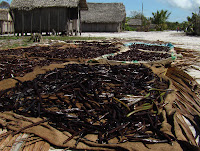
Statistics claim that Madagascar (with Reunion and Comoros) produces something like 80% of the world's vanilla, and most of it is exported to the USA and Europe for ice cream production. It is also one of the main commodities produced in the very fertile SAVA region, others being rice, coffee, banana's, bread fruit, mangoes, coconuts, jackfruit, and others. The beautiful aroma of vanilla pods drying in the villages near where they grow is incongruous with the shiny and chocolaty brown pods that I see on the grass mats outside many of the village dwellings.
Speaking to the local farmers, they gladly describe to me the lengthy process and the years of effort and skill required to cultivate and prepare this commodity - very little of which is used locally, simply because it's value on the international market more than outweighs any opportunities for local consumption. A host plant, such as jatrofa must be prepared and planted, in just the right soil, with just the right aspect, and just the right amount of sun and shade to accommodate the vanilla vines. Lengths of vine are hand-planted individually at the base of the host, and after a few years (if not taken by disease) will begin producing the green beans. Pollination is by hand only, and each flower must be pollinated individually.


When the beans are ripe, they are hand picked and gathered. Soon they must by boiled in a specially constructed basket in a large cauldron over a wood fire for an exact number of minutes. On removal from the boiling water they are hurriedly wrapped in insulating material and put away for 2 days so that they remain at a high temperature. They must then dry in doors for some time before they can be laid out to dry in the sun. A year later they are dry enough to be sold to the co-operatives or transported to the nearest town. Bundles are individually prepared and each pod is massaged and stretched like a stiff muscle before it is bundled.

Such is the effort that gets put into preparing this bean which is then used in luxury food items.

Many stories and situations accompany these plump, sliverry shiny beans:
1) I met a vanilla farmer who, taking a break from stretching sinuous pods in his hand walked up to me and shook my hand. A few minutes later I lifted my hand to remove my hat, only to catch a whiff of the sweet aroma. Examining my hand I saw tiny little black specks, and realised that I had received my first authentic vanilla shake!
2) An English speaking student in the town of Sambava told me of the town thieves who prey on Vanilla merchants at night using their fine sense of smell.
3) Another Malagasy told of the dodgy Vanilla co-operatives who fill the pods with nails to bulk up the weight that they are sold at.
4) In books at tourist venues I found recipes for canard a la vanille (Vanilla duck), and in one fancy restaurant in Tana I had the most delectable meal of grilled fish in a creamy vanilla sauce.
5) Shops everywhere sell the delicious Malagasy vanilla yogurt in their plastic returnable cups, sweet and full of little black specks that I first mistook for dirt and refused to eat it!
6) Another NGO worker told me that farmers will destroy all their food crops to plant vanilla when the international price is soaring, and who then become destitute when the price falls again.
7) It felt decadent to be able to buy several large, heavy bundles directly from the farmers at a tiny fraction of the price it is sold in Antananarivo, let alone the price you'll pay for a dried out sliver in my local deli or speciality store in Cape Town.

And that is a short story of my encounter with this mysterious and notorious bean of the Red Island.

Stephen

Colours from Madagascar

Look what we found in the Madagascar National Park coumpound in Andapa village.... (This was taken on my cellphone as we didn't have our camera with us...)


The Red Island holds our hearts


Returning from Madagascar two weeks ago to Cape Town was tough.
After a month of travelling, filming and connecting with Malagasy people in some of the more remote regions of the country, it feels like life in Cape Town is too fast, full and intense. Comparably our daily lives in the rain forest regions of the north-east
and drier regions of south-west felt simple, clear and uncluttered.
Don't get me wrong, we were working all the time! We were meeting new people (villagers, conservation officials, guides, boatmen, young English students) everyday, filming on 2 cameras everyday (there was always something new and unique to capture) or arranging what the next location would be, and how we would get there.
But somehow, it felt that with our one objective of making a film that connects climate change, conservation and the beautiful people of Madagascar, we could stay focussed.

We we absorbing and capturing images in some of the most beautiful places I have ever been in the world. The Masoala National Park and adjacent coastline is a unique ecosystem where the rainforest literally meets the ocean. Tendrils of creeping vines hang over the yellow beach, brown-fronted lemurs eat leaves from the 100-year-old gnarled tamarind trees, a step away from the warm sea. Beyond the black rocks off the beach, the bay is filled with brightly coloured tropical fish and deeper in Antongil Bay, whales frolick with their calves.
Its breathtaking.

The Marojejy region, further up north gave us the opportunity to meet vanilla and coffee farmers. This was where we got our first REAL vanilla shake.... which is the most welcome, hearty handshake from a friendly vanilla farmer in this region! Malagasy people don't do confrontation, its just not part of their culture. So no one is ever angry or upset but always relaxed and open to whatever comes their way. Its makes for peaceful meetings and discussions. Always.
Here we also saw up close the silky Sifakas, which is a highly endangered species of lemur that lives only in certain parts of the island. And many other endemic reptiles, plants and gorgeously coloured birds. I miss the rain forests...


The rainforest regions we visited are so lush, that it became difficult to see the hardship and climate related problems the people here are experiencing.
But when we travelled to the south west near Toliara, the dryness and scarcity of water makes everything a lot clearer.
Water is scarce.
We filmed an extended family digging a well in a dry river bed to find water. It would take them whole day to find something. 50 km up the main road, people are travelling 7 or 8 km by foot to collect water in big buckets. And this will only get worse with the current predictions of climate shifts...

And now, back in CT, the work is in full swing. Local Malagasy people are doing translations for us via email, and I'm starting to sort and arrange all this footage we captured into something meaningful. And thats the challenge - turning such a rich, meaningful trip into a film that will move hearts and minds.

Watch this space.
Jacqueline


Wednesday, 1 September 2010

Joyce's Choices goes on Tour to the Eastern Cape!

On August 23rd, a small committed team set out from Cape Town to take Joyce's Choices (an innovative, interactive and high-quality performance) on a school tour! Reaching this point had taken months and months of hard work, preparation and determination. As we pulled out of Cape Town heading up the N2, Joyce was on her way to being introduced to learners at a variety of schools between Knysna and Port Elizabeth.

On the 23rd though, the number of performances was still uncertain because of the national strike underway...teachers were striking all over and many schools were uncertain about the week ahead. Principals were concerned about the possibility of intimidation and having to close schools completely. Even so, we set out with 3 confirmed performances, trusting that other performance opportunities would emerge as we travelled. We were right, when the week ended we had given 5 performances! Joyce, Nandi and Greg had met over 600 learners!

Each performance was unique because the environment and the audience gave the experience its own flavour. Our first performance took place in Kwanokuthula, a township just outside of Plettenberg Bay. We performed for mixed age group of 26 children residing at the Masizame Child and Youth Care Centre. The audience comprised of children between the ages of 7 and 15...their response to the performance was one of delight and for most of them it was the first time they were seeing a show with a puppet. They shrieked with delight when Joyce made her first appearance on stage. Fundi's sudden appearance from the TV for the game show "It's your choice" brought even more excitement! Throughout the show, the audience was engaged in what was happening.

Our second performance was on Wednesday at Bay College an Eco School outside of Plettenberg Bay. We performed for around 40 learners between grade 8 and 11. On Thursday, we were at the Crags Primary School in Kurland Township, performing for over 200 learners spanning grade 7 to 9. Our Friday morning was packed with a very early morning performance for around 150 learners at Collegiate High School and a second performance at Victoria Park High School for around 140 learners - both schools in Port Elizabeth.

Four of the performances from our first week on tour were followed by a workshop. This was an exciting space where audience members were asked to reflect on the content of the play and to imagine a world that they wanted to live in one day. It was amazing for all of us to see the future which many of the young people were longing for! Their futures were filled with restored natural environments and complex technologies to address the imact of climate and human needs. They were creative, inspiring and complex. Once the workshop participants had created their imagined worlds, we asked them to identify the specific actions they could take in their lives to begin to create a world they wanted to live in. This brought the discussion back into the present...again we were continuously reminded of the resourcefulness and resilience of young people to tackle the challenges they will have to face in their future!

More news to follow about the second leg of the tour at schools in and around Cape Town!

Tahirih Cook

Monday, 19 July 2010

Voices from the Red Island – A documentary film


Cosmos Productions has been recently granted funds by the NGO, Conservation International to make a documentary film that will give a voice to the local people of Madagascar. So we’re going back 1 year later, in August 2010!

On this project, I am collaborating with Stephen Davis (my husband) to create Voices from the Red Island, a social and environmental documentary film that captures how social and environmental issues intersect at critical points on the beautiful and fragile island of Madagascar.

Some info about the film….

The indigenous, rural people of Madagascar live in close connection to their natural environment. Their livelihoods depend on the natural world and inherently the forests and biodiversity of ‘the Red Island’ – the name coming from the colour of her fertile soil. With the current plundering of rainforests of rare hardwoods, (after a political coup that happened in February 2009 that left the country with weak rule of law), coupled with the devastation of 90% of the country’s forests for agriculture and charcoal through slash and burn practices, this natural environment is dwindling at a rapid rate. People living on the periphery of the forests are putting more and more pressure on Madagascar’s parks and reserves. At the same time, the local rural people experience climate changes and seasonal shifts that are happening on a global scale, as real problems. Cyclones are more intense, dry and rainy seasons are too short or too long, and crop yields are lower or entirely destroyed by extreme weather events.

For these people, climate change is already a reality, although they may not know how to name the phenomenon, they are increasingly realizing that the changes are not just an environmental issue, but also one with severe socioeconomic implications. It is a potential threat to their very existence and a major issue of human rights and equity.

This film aims to give a voice to these people.

We feel that at the interface of environmental destruction and climate change impacts, personal stories as testimonies of the adversities of climate change will move the hearts and minds of people in developed countries to redress the differences in ability to adapt and respond to the challenges of climate change and environmental degradation. Voices from the Red Island will demonstrate the interconnectedness of the human race; of actions, consequences and accountability.

So stay connected to our blog as we’ll be bringing you more updated info as we progress!

Jacqueline